
SRD Status Shows Active But You Never Applied
Published: Modified: Last verified: 27 August 2026 Written by: Themba Matlou
If your SASSA SRD status shows active but you never applied and have never been paid, someone else has almost certainly applied using your ID number. This is identity fraud. To act on it you need three things: a SAPS case number, a report to SASSA on 0800 60 10 11, and a check with the banks to see whether an account was opened in your name. People born between 2002 and 2006 are the most affected group.
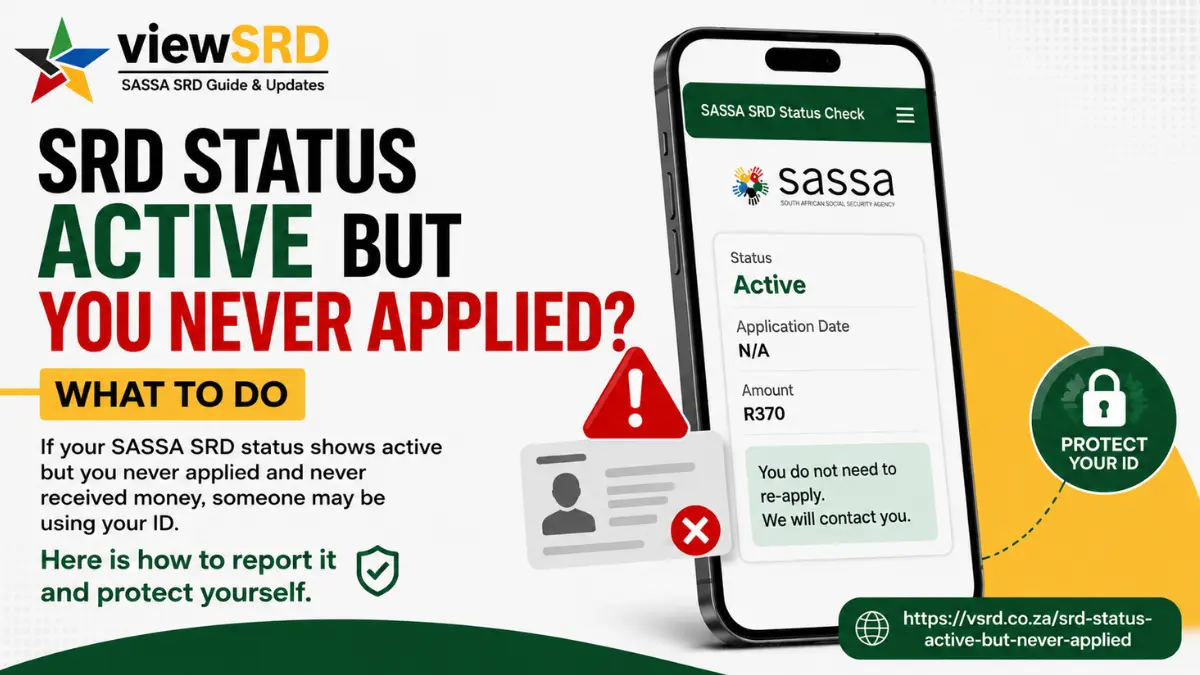
- What it means: someone applied for the SRD grant using your ID number
- Most affected: people born between 2002 and 2006
- First step: open a SAPS identity theft case and get the case number
- Report to SASSA:0800 60 10 11
- Also check: whether a bank account exists in your name
- Cost: reporting is free. Nobody may charge you to fix this
Thousands of South Africans have discovered an active SRD application on SASSA's system that they never submitted. In many of these cases the grant is being paid every month into a bank account the real ID holder never opened. The problem was formally raised in Parliament in October 2024 and SASSA has publicly acknowledged it. This page explains what the status means, why young people are targeted, and the exact steps that have worked for other victims.
What Does an Active SRD Status Mean If You Never Applied?
An active SRD status on an application you never submitted means someone else applied using your 13-digit South African ID number. The SASSA system links an application to an ID number, not to a person. If a fraudster enters your ID number with their own phone number and their own bank details, the system treats it as your application.
This is why you can see a status but never receive money. The application exists in your name. The payment goes somewhere else.
| What you see | What it usually means |
|---|---|
| Active status, you never applied, never paid | Someone applied with your ID and is receiving the money |
| You try to apply and are told the ID is already in use | A fraudulent application already exists on your ID |
| Approved status but the phone number is not yours | The profile is linked to a number the fraudster controls |
| Your phone number changed without you doing it | Someone has taken control of your SRD profile |
This is different from a genuine application that is simply pending or delayed. If you did apply and your status has not moved, that is a separate issue.
Applied yourself and waiting? →SRD status pending explainedWhat a pending status means and how long it normally takes.Why People Born Between 2002 and 2006 Are Most Affected
Young South Africans who turned 18 after the SRD grant launched in 2020 are the group most targeted by this fraud. They usually have a valid ID number, no bank account history, and no reason to ever check SASSA's system. A fraudulent application on their ID can run for years before anyone notices.
The scale of it was uncovered in October 2024 by two first-year Computer Science students at Stellenbosch University, Joel Cedras and Veer Gosai, after they found that SRD applications had been submitted in their own names without their knowledge. They presented their findings to Parliament's portfolio committee on social development.
| What was measured | Result |
|---|---|
| SRD applications for people born in February 2005 | 74,931 |
| Actual births recorded that month (Stats SA) | 82,097 |
| Application rate for that birth month | About 91% |
| Average application rate, birth years 1960 to 2006 | About 52% |
| Application rate, birth years 2002 to 2006 | About 90% |
| Campus survey of 60 people they knew | 58 had active applications; 56 said they never applied |
SASSA acknowledged the problem. Brenton van Vrede, the agency's Executive Manager for Grants Administration, said there were many such cases and that a larger operation was likely behind them. He also said that three banks had not properly applied FICA requirements, which made it possible for fraudsters to open bank accounts using other people's ID numbers.
If you were born between 2002 and 2006 and have never checked your SRD status, it is worth checking even if you have no interest in the grant. An application may already exist in your name.
How the Fraud Actually Works
Understanding the mechanics helps you know what to ask for when you report it.
- Your ID number is obtained. ID numbers leak from data breaches, job applications, copied documents, and forms handed over in everyday situations.
- An application is submitted in your name. The fraudster uses your ID number with their own cellphone number, so every SMS and verification link goes to them.
- A bank account is opened using your ID. This is the step that lets them collect the money. It is also why checking with the banks matters.
- The grant is paid every month. The application sits under your name while the payments go to an account you have never seen.
This is why simply reporting it to SASSA is not always enough. If a bank account exists in your name, that account is a separate problem you need to close.
Warning Signs Your ID Has Been Used
- Your status shows active, approved or pending on an application you never submitted
- You try to apply and are told your ID number is already in use
- Your SRD profile shows a cellphone number that is not yours
- Your registered phone number changed without you requesting it
- You receive SASSA SMS messages about an application you never made
- A bank contacts you about an account you did not open
- You are refused credit for reasons you cannot explain
Any one of these is enough reason to open a case. You do not need to prove the fraud yourself before reporting it.
Step 1: Open a SAPS Identity Theft Case
Do this first. Without a police case number, SASSA cannot process your report as fraud. Victims who called SASSA without a case number have generally been told to open one before anything could move.
- Go to any police station. You do not have to use the one nearest your home.
- Take your green ID book, smart ID card, or a valid temporary ID.
- Report it as identity theft and fraud. Say that your ID number has been used to apply for a SASSA SRD grant without your consent.
- Ask for the CAS number and write it down. This is the number every other organisation will ask you for.
- Ask for a copy of the statement you sign.
Opening a case is free. If anyone asks you to pay to open a case or to "speed it up", that is not a legitimate request.
Step 2: Report It to SASSA
With your CAS number in hand, contact SASSA on the toll-free line.
- Call 0800 60 10 11
- Say clearly: "I want to report identity fraud. My ID number has been used to apply for an SRD grant without my consent. I have a police case number."
- Give them your ID number and your CAS number.
- Write down the reference number they give you, the date, the time, and the name of the person you spoke to.
- Ask them directly: will the fraudulent application be marked as fraud, and how long will that take?
Keep every reference number in one place. In documented cases, victims had to call several times before anything changed, and the record of previous calls was what made the difference.
Verify the current toll-free number on sassa.gov.za before calling. Numbers do change, and fake "SASSA helplines" are advertised on social media.
Step 3: Go to a SASSA Office in Person
Phone calls alone have not worked for many victims. An in-person visit creates a paper record that a call centre note does not.
- Take your ID, your CAS number, and the reference number from your phone call.
- Take a printed copy of your status showing the application you never submitted, if you can.
- Ask for a written acknowledgement that you reported the fraud.
- Ask the officer to note that the application must be cancelled and the ID flagged.
- Get the name and contact details of the person who assisted you.
Go early. Queues at SASSA offices are long, particularly in the last week of the month when payments are released.
Step 4: Check for Bank Accounts Opened in Your Name
This is the step most people miss, and it is often where the money is actually going. In the documented cases, fraudsters opened bank accounts using the victim's ID number and had the grant paid into those accounts every month.
- Contact the major South African banks and ask whether an account exists under your ID number.
- Have your ID and CAS number ready. They will need to verify you first.
- If an account is found, ask the bank to freeze it and open their own fraud investigation.
- Ask for a written record of the account and the transactions. SASSA may require this.
- Check your credit report to see which accounts are linked to your ID.
A bank cannot discuss an account with you until they have confirmed your identity. Expect to be asked security questions, and be patient with the process.
Banking details →How SASSA banking details workHow grant payments are linked to a bank account, and how to change them.Step 5: Protect Your ID Number for the Future
Reporting the fraud does not stop it happening again. These steps reduce the risk.
- Register with SAFPS Protective Registration. The Southern African Fraud Prevention Service offers a free service that flags your ID number so that organisations apply extra verification before opening accounts in your name.
- Check your credit report regularly. South African credit bureaus provide a free report each year.
- Check your SRD status every few months, even if you have no interest in the grant, so a new fraudulent application is caught early.
- Never share your ID number, OTP or PIN with anyone offering to help you apply.
- Be careful with copies of your ID. Write the purpose and date across any copy you hand over.
SASSA never charges a fee to apply, to fix an application, or to release a payment. Anyone asking for money to help you is running a scam.
What to Do If SASSA Does Not Respond
Victims have reported calling repeatedly with no result. If that happens, escalate in writing.
- Send a written complaint to SASSA setting out every date, reference number and name from your previous contact. Keep a copy.
- Contact your provincial SASSA office rather than only the national call centre.
- Approach Black Sash. They are a long-established South African organisation that assists people with social grant problems, free of charge.
- Lodge a complaint with the Public Protector if a state body has failed to act on your matter.
- Contact your local Member of Parliament or ward councillor. Grant fraud has been raised in Parliament and constituency offices can escalate cases.
Keep every document. A written trail is what moves a case that phone calls have not.
How Long Does This Take, and Will You Get the Money Back?
There is no fixed timeframe, and we cannot promise you an outcome. We would rather tell you that than repeat a number we cannot support.
What the documented cases show is that resolution has been slow and inconsistent. Some victims found that months after reporting, their applications were still not marked as fraudulent. Others were unable to reach a regional office at all. The students who raised the matter in Parliament described exactly this experience.
On recovering money already paid to a fraudster: that is handled between SASSA, the bank and the SAPS investigation. It is not something you can arrange yourself, and it is not guaranteed. Your realistic goal is to stop the fraudulent application, clear your ID, and be able to apply legitimately if you qualify.
Persistence is what has worked. Keep calling, keep records, and escalate in writing when calls do not produce a result.
A Real Case: What One Family Went Through
A mother contacted us about her daughter, who turns 21 shortly. Her daughter had been trying to access the R370 grant since she received her ID. When she checks the SASSA website, the status shows active. She has never applied and has never received a single payment.
The family phoned SASSA several times. Each call was logged. They were told that SASSA would try to stop whoever was receiving the money. Months later, nothing had changed. The daughter is not working and is looking for a job. The money would have made a real difference.
Her situation matches the documented pattern exactly. She was born in 2005, in the birth years where application rates were roughly 90% instead of the 52% average. Her status is active. The payments go somewhere else.
Two things stand out. First, phone calls alone had not resolved it after repeated attempts, which is why a police case number and an in-person visit matter so much. Second, nobody had told the family to check whether a bank account had been opened in her daughter's name, which in the documented cases is where the money was being collected.
Shared with the family's permission. Names and identifying details have been withheld. If you are in the same position, the steps above are the ones that have moved cases forward.
Frequently Asked Questions
My SRD status is active but I never applied. What does that mean?
It means an SRD application exists on your ID number. Since you did not submit it, someone else did, using your ID with their own phone number and bank details. The application sits in your name while the payment goes to them.
Someone is receiving my SRD grant. What do I do first?
Open an identity theft case at any police station and get the CAS number. Then call SASSA on 0800 60 10 11 and report the fraud with that case number. Without a police case number, SASSA generally cannot process the report as fraud.
Why are people born between 2002 and 2006 targeted?
They turned 18 after the SRD grant launched in 2020. They have valid ID numbers, often no banking history, and little reason to check SASSA's system, so a fraudulent application can run undetected for years. Research presented to Parliament in 2024 found application rates of around 90% for these birth years, against a 52% average across all years.
Can I just apply again with the same ID number?
No. The system will reject a second application on the same ID and will tell you the ID is already in use. The fraudulent application has to be cancelled first, which is why reporting it is the only route.
Will I get back the money the fraudster received?
We cannot promise that. Recovery is handled between SASSA, the bank and the police investigation. Your realistic goal is to stop the fraudulent application and clear your ID so you can apply legitimately if you qualify.
Does it cost anything to report SRD fraud?
No. Opening a police case is free, calling SASSA on the toll-free line is free, and visiting a SASSA office is free. Anyone who asks you to pay to fix your application is running a scam.
How do I find out if a bank account was opened in my name?
Contact the major South African banks directly and ask whether an account exists under your ID number. Have your ID and police case number ready. You can also check your credit report to see which accounts are linked to your ID.
I reported it and nothing happened. What now?
Escalate in writing. Send a written complaint to SASSA listing every date, reference number and name from your previous contact. Contact your provincial SASSA office rather than only the call centre, and approach Black Sash, which assists with social grant problems free of charge.
Can ViewSRD cancel the fraudulent application for me?
No. We are an independent information website with no connection to SASSA and no access to any application, status or payment. Only SASSA can cancel an application. This page exists to point you to the correct official channels.
Official Contacts and Sources
Always confirm contact details on the official SASSA website before calling. Fake SASSA helplines are advertised on social media.
| Service | Official Link / Contact |
|---|---|
| SASSA toll-free helpline | 0800 60 10 11 |
| SASSA official website | sassa.gov.za |
| Official SRD portal | srd.sassa.gov.za |
| SAPS — report identity theft | Any police station, in person. Ask for the CAS number. |
ViewSRD is an independent South African information platform. We are not affiliated with SASSA, the Department of Social Development, the South African Police Service or any bank. We cannot access, change or cancel any grant application.
Related Guides
Identity verification →How SASSA verifies your identityWhy identity checks fail and what SASSA checks against.Change your phone number →Update the number linked to your SRD profileYour whole SASSA profile is tied to the number you registered with.Appeals →How to appeal a declined SRD applicationWhat to do when your application is refused and you believe you qualify.- - Initial publication. Added guidance for SRD applications submitted fraudulently on another person's ID number, including the 2024 parliamentary findings, the reporting process, bank account checks, and escalation routes.